
What Is A Carbon Credit? (In Plain English)
Think of two identical factories.
Factory A has solar panels. Factory B doesn't.
Factory A produces less CO₂ than Factory B — and that reduction can be independently measured. Once it's been measured and verified, it becomes something called a carbon credit: one credit for every tonne of CO₂ avoided.
Big organisations with sustainability targets — corporates, banks, airlines, government bodies — buy those credits to offset their own emissions and hit their Net Zero commitments. There's a real market for them, with real buyers, paying real money.
So the greener your business becomes, the more your solar system is worth — not just in bills saved, but in credits generated.
Why Sunbase Refunds Yours
Under a standard PPA, the funder owns the panels and the environmental rights they generate. Most providers quietly keep the carbon credits. We don't. And if you're using Asset Finance or fully paying for your own system (installed after April 2026), you shouldn't miss out either.
We think you should have that money, regardless of how you fund your solar.
Every year, Sunbase calculates the verified carbon reduction your system has delivered, converts it into credits, sells them, and refunds the proceeds back to you. It sits alongside your electricity savings as a second annual financial benefit.
You get:
- ✓The 30–50% savings on your electricity bill
- ✓Plus an annual refund from the carbon credits your system generates
- ✓No upfront cost, no involvement in the paperwork, no risk
Commercial Solar Carbon Credits — How It Works
Turning reduced grid electricity into measurable carbon savings. The process runs quietly in the background — you don't need to lift a finger.
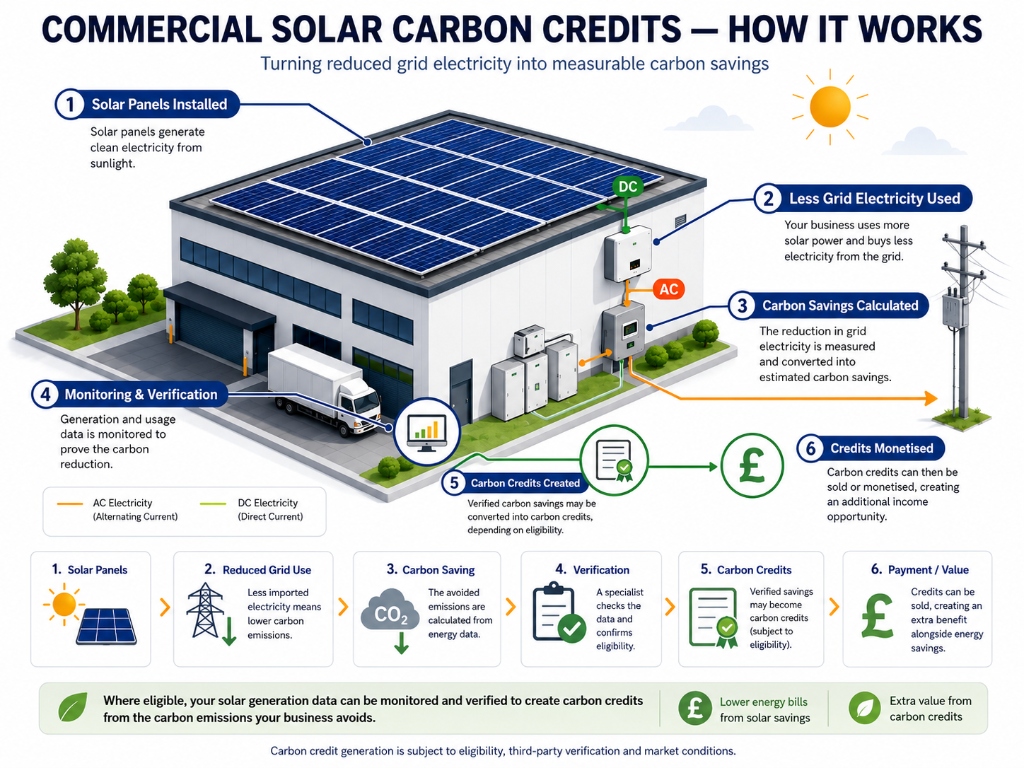
Solar Panels Installed
High-efficiency solar panels are installed on your commercial roof or land to generate clean, renewable electricity directly from sunlight.
Less Grid Electricity Used
Your business consumes self-generated solar power first, drastically cutting your reliance on carbon-intensive electricity from the national grid.
Carbon Savings Calculated
Smart inverter data and meter readings calculate the precise reduction in grid electricity, converting it into measured tonnes of avoided CO₂ emissions.
Monitoring & Verification
Generation and usage data is continuously audited by independent verification standards to formally prove and certify the carbon reduction.
Carbon Credits Created
Verified carbon savings are minted into officially registered carbon credits (1 credit = 1 tonne of CO₂ avoided), subject to site eligibility.
Credits Monetised & Refunded
Carbon credits are sold on voluntary carbon markets to organisations seeking verified offsets, with proceeds refunded directly back to your business.
Carbon credit generation is subject to eligibility, third-party verification and market conditions.
What Could It Be Worth?
Honest answer: it depends. Prices are set by the market — by how much buyers want to pay on the day, the size and performance of your system, and the profile of your organisation. We won't pretend to know exactly what your system will produce until we've assessed the site.
As a rough guide, based on current market observations:
Standard commercial projects currently see values around £50 per tonne of verified carbon saved
Projects with a social or community angle — schools, care homes, charities, community centres, housing associations, public sector buildings — often achieve £100–£250 per tonne, because the extra social value attracts higher-paying buyers
A 400kWp commercial rooftop system typically avoids somewhere in the region of 80–100 tonnes of CO₂ per year. At £50 a tonne, that's a ballpark indicator — not a promise. We'll give you a projection specific to your site as part of your free assessment.
Market values fluctuate. Revenue isn't guaranteed and depends on verified performance, buyer demand and prevailing conditions.
Common Questions
Who is eligible for Carbon Credit refunds?
Any business that installs solar through a Sunbase PPA or Asset Finance. It also applies to any business that fully pays for their own solar system, provided it is installed after April 2026.
Do I own my solar panels?
Under a PPA, the panels are owned by the funder for the term of the agreement — that's what lets us fund the whole install with nothing from you. At the end of the term, you can buy the entire system for £1. If you use Asset Finance or pay outright, you own them from day one.
Does this affect ownership of my building or roof?
No. Nothing about the carbon credit process changes anything about your property.
Do I have to do any of the admin?
No. Sunbase and our verification partner handle registration, monitoring, verification and sale. You just receive the refund.
How soon do the credits start earning?
The monitoring meter goes in with the panels. Registration and the first verification cycle typically complete within 4–6 weeks of switch-on. Once credits are ready for sale they can move quickly, or take a few months, depending on the market.
What if the market softens in a bad year?
The refund is based on what your credits sell for. In a strong year that's more; in a weaker year it's less. Either way, it's money you weren't getting before — and the electricity savings under your fixed PPA rate are unaffected.
Do all providers do this?
No. Most PPA providers keep the credits without ever mentioning them to the client. If you're already looking at a PPA quote from another provider, it's worth asking who owns the environmental rights.
Ready To See What Yours Could Be Worth?
Book a free site assessment. We'll give you a projected electricity saving, a projected carbon reduction, and an indicative view of what the credit refund could add on top.